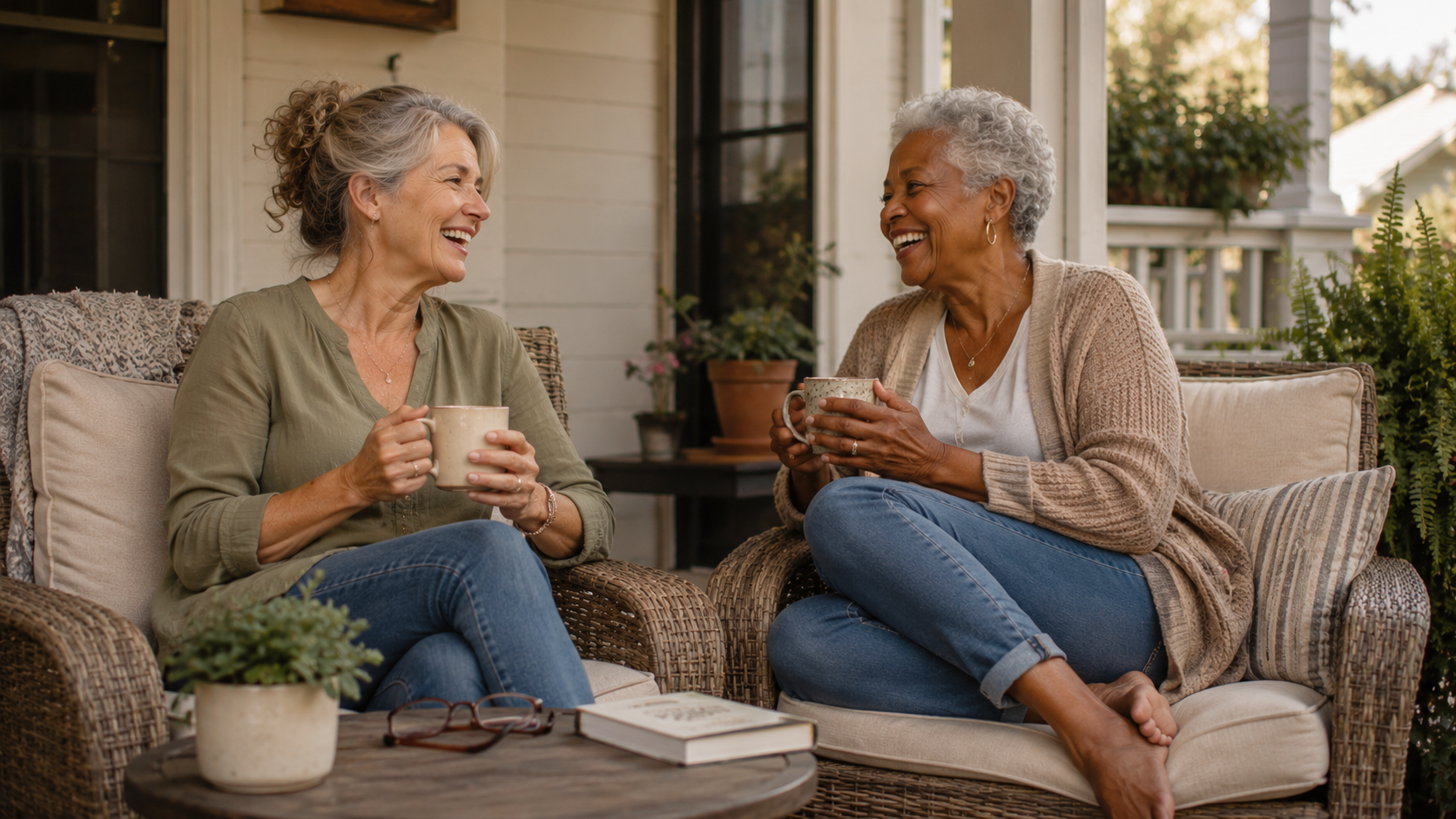
Companionship After 50: You Do Not Have to Want Romance to Want Connection
If you are over 50 and feel the pull toward connection but not necessarily toward dating, romance, or marriage, you are not alone. Millions of adults in their 50s, 60s, and beyond want companionship — someone to share meals with, talk to in the evening, travel alongside, or simply know is there.
Companionship after 50 means having a steady, meaningful connection with another person — one built on presence, conversation, and mutual care rather than romantic milestones. It can look like friendship, partnership, affection without labels, or something entirely your own.
That is not settling. It is choosing with clarity.
Why Companionship Matters After 50
Loneliness after 50 is more common than most people admit. Retirement, divorce, widowhood, children leaving, and friend circles shrinking can leave a gap that no amount of busyness fills. Research consistently links social isolation in midlife and beyond to poorer health outcomes, depression, and cognitive decline. The effects are not abstract — isolated adults report lower energy, less motivation, and a pervasive sense that daily life lacks meaning.
Loneliness after retirement hits particularly hard. Work provided structure, social contact, and identity. When that disappears, even people who looked forward to retirement can find themselves adrift. The same is true after divorce or after children move away — the rhythm of life that kept loneliness at bay simply vanishes.
But here is what matters most: loneliness is not a character flaw. Feeling lonely after 50 does not mean you failed at building a life. It means you are human, and humans need connection at every stage.
The need for companionship as you age is biological, psychological, and practical. Having someone to check in with, laugh with, or sit beside changes the texture of daily life. It does not have to be a spouse. It does not have to be romantic. It simply has to be real.
If you are feeling lonely after 50 and wondering whether you are ready to seek connection, you might find it helpful to read Am I Ready to Date Again After 50? — even if dating is not your goal, the self-assessment questions apply to any form of connection-seeking.
What Does Companionship Mean in a Relationship?
People use the word “companionship” to mean different things. For some, it is a gentle word for partnership. For others, it specifically means “not romance.” Both uses are valid.
At its core, companionship in a relationship means:
- Consistent presence — Someone who shows up regularly, not just when it is convenient
- Emotional availability — Willingness to listen, share, and care about each other’s lives
- Shared activities — Doing things together that both people enjoy
- Mutual respect — Honoring each other’s independence, boundaries, and pace
- Low pressure — No script, no escalation timeline, no assumed destination
A companion is not a project, a therapist, or a placeholder for something “better.” A companion is someone who makes ordinary life less solitary — and that is enough.
Companion vs Partner: Is There a Difference?
The distinction is personal. Some people use “companion” to signal that they want connection without the obligations traditionally tied to “partner” — shared finances, cohabitation, family integration. Others use the words interchangeably.
What matters is not the label. What matters is that both people share an understanding of what they are building together.
Companionship vs Romantic Relationship
Many people searching for companionship after 50 want to understand how it differs from a romantic relationship. Here is a practical comparison:
| Companionship | Romantic Relationship | |
|---|---|---|
| Primary focus | Presence and shared life | Emotional and physical intimacy |
| Physical affection | Optional, defined by both people | Generally expected |
| Exclusivity | Negotiable | Often assumed |
| Progression | Stays where it works | Typically moves toward deeper commitment |
| Living situation | Often separate homes | Often moves toward cohabitation |
| Social framing | ”My friend,” “my companion,” “my person" | "My partner,” “my boyfriend/girlfriend” |
| End goal | Ongoing connection | Often marriage or long-term partnership |
Neither model is superior. Some people want romance and companionship together. Some want one without the other. Both are complete choices.
Types of Companionship After 50
Companionship is not one-size-fits-all. Here are the forms it commonly takes:
Platonic Companionship After 50
A close, committed friendship without romance or physical intimacy. You might share weekly dinners, travel together, attend events as a pair, or be each other’s emergency contact. Platonic companionship after 50 is far more common than people realize — and far more sustaining than casual acquaintance.
Romantic Companionship
Connection that includes affection, physical closeness, and emotional intimacy but without the assumption of marriage, cohabitation, or merged lives. Many people over 50 build deeply satisfying romantic companionships while maintaining separate homes and finances.
If this model interests you, Living Apart Together After 50 explores how couples maintain closeness with independence.
Activity-Based Companionship
A relationship built around shared interests — hiking partners, travel companions, bridge partners, co-volunteers. The activity is the anchor, and the connection grows around it.
Emotional Companionship
Someone you talk to regularly and deeply. The person you call when something happens — good or bad. This may or may not include in-person time, but the emotional bond is the center.
Looking for Companionship, Not Romance: That Is Valid
If you have ever thought “I just want someone to talk to” or “I am not looking for love, just company,” you do not need permission — but you have it anyway.
Looking for companionship not romance is a legitimate, complete choice. It is not a stepping stone to “real” dating. It is not a sign of emotional avoidance. It is not less ambitious.
Many adults over 50 have already had the big love story. Some are still healing from one. Some never wanted one in the first place. Whatever your history, wanting companionship without romance is a clear, mature decision about how you want to spend your time and energy.
You do not owe anyone an explanation for why you are not looking for more.
If this is the part you are trying to name, When You Want Companionship More Than Romance After 50 goes deeper into how to recognize that preference, say it clearly, and handle mismatched expectations without apologizing for what fits your life now.
When the need for company becomes sharper around Christmas, New Year’s, or changing family traditions, Companionship During the Holidays After 50 offers a seasonal plan without treating dating as the automatic solution.
How to Find Companionship After 50
Finding companionship requires slightly different strategies than finding a romantic partner. Romance often starts with attraction. Companionship starts with proximity and repetition.
1. Join Activity-Based Groups
Classes, clubs, volunteer organizations, and community programs put you in regular contact with the same people — which is how friendship and companionship naturally form. Look for:
- Community education classes (art, cooking, language, technology)
- Walking or hiking groups
- Volunteer positions with consistent schedules
- Book clubs, garden clubs, or hobby groups
- Faith-based communities
2. Use Companionship Apps for Seniors
Several platforms specifically serve adults seeking non-romantic connection:
- Stitch — designed for adults over 50, includes companionship-focused matching
- Meetup — group-based activities organized by interest and location
- Bumble BFF — friend-finding mode within the Bumble app
- Nextdoor — neighborhood-based connections and groups
Some traditional platforms also allow you to specify that you are seeking companionship rather than romance. Be clear in your profile about what you want.
If you explore online platforms, familiarize yourself with Romance Scam Warning Signs — scammers target people seeking companionship just as often as those seeking romance.
3. Reconnect With Lapsed Friendships
People you lost touch with after retirement, divorce, or a move may be experiencing similar loneliness. A simple message — “I have been thinking about you. Want to grab coffee?” — can restart a connection faster than building one from scratch.
4. Say Yes to Invitations (Even Small Ones)
Loneliness after retirement often deepens because social invitations slow down and the ones that arrive feel unimportant. Say yes anyway. Companionship grows from accumulated small moments, not grand gestures.
5. Consider a Grief or Transition Support Group
If you are finding a companion after your spouse dies or after a major divorce, groups built around shared experience provide both understanding and potential companionship. The people in these rooms already know something important about your life.
6. Be the One Who Initiates
After 50, many people wait to be invited. Be the person who suggests lunch, proposes a walk, or organizes a small gathering. Initiative is the single most effective companionship strategy.
7. Try a Structured Social Program
Senior centers, community colleges, travel groups for solo adults, and organizations like AARP offer structured opportunities designed for connection. These remove the awkwardness of cold outreach.
8. Be Honest About What You Want
Whether you meet someone online, through friends, or in a group — tell them. “I am looking for companionship, not necessarily romance” is a sentence that saves both people time and creates space for honest connection.
When the conversation moves from general wording to expectations, how to talk about what you want after 50 offers calm language for naming companionship, pace, commitment, and what you are not ready to promise.
Companionship Boundaries: What to Discuss Early
Companion relationships work best when both people communicate clearly about expectations. Without the cultural script that romance provides (first date, exclusivity talk, moving in), companion relationships need their own framework.
Discuss these topics early and revisit them as the relationship evolves:
- Time and frequency — How often will you see each other? Is daily texting expected or overwhelming?
- Exclusivity — Are you each other’s only close companion, or do you both maintain other close connections?
- Physical affection — Is hugging, hand-holding, or other touch welcome? Where are the limits?
- Financial independence — Will you split costs, take turns, or keep finances entirely separate?
- Living arrangements — Separate homes, or openness to something else eventually?
- Family involvement — Will you meet each other’s families? Attend holidays together?
- Health and caregiving — What happens if one person gets sick? Is there an expectation of care?
- Communication about change — If one person’s feelings shift, how will that be handled?
These conversations may feel awkward, but they prevent the kind of hurt that comes from mismatched assumptions. If you want connection without the framework of traditional commitment, Dating Without Remarrying addresses how to build relationships outside conventional expectations.
Finding a Companion After Your Spouse Dies
Widowhood brings a particular kind of loneliness. You may not feel ready to “date” — the word itself may feel wrong — but you miss having a person. Someone who knows your schedule. Someone who cares whether you made it home.
If this is where you are:
- You do not need to be “over” your grief to want company. Grief and the desire for connection coexist. One does not cancel the other.
- Companionship is not replacement. A new companion does not erase your late spouse or diminish what you shared.
- Start where it feels safe. A grief support group, a walking partner, a neighbor you invite for weekly tea. Companionship after loss often begins with very small steps.
- Let people know what you need. “I am not looking for romance, but I would love regular company” is a sentence that opens doors without pressure.
For a more detailed guide on navigating connection after loss, read Dating After Widowhood — it covers readiness, guilt, timelines, and first steps with no pressure and no judgment.
What to Expect From a Companion Relationship
If you have never had a companion relationship — or if your only model is marriage — it helps to know what healthy companionship typically looks like:
- It feels easy more often than hard. Low-drama, low-pressure connection is the point.
- It evolves slowly. Without a romantic escalation script, companion relationships deepen at their own pace.
- It requires maintenance. Even low-key relationships need initiative, communication, and care.
- It can end without failure. If a companionship runs its course, that does not mean it failed. It means it served its purpose for a time.
- It may surprise you. Some companionships stay exactly what they started as. Others grow into something deeper. Both outcomes are fine.
If you are unsure whether your companion relationship feels healthy or whether certain patterns deserve attention, Healthy vs Toxic Relationship Patterns After 50 walks through the signs at a practical level.
When Companionship Becomes Something More
Sometimes a companion relationship develops into something romantic. That is not the goal — but it is not a problem either.
If you notice your feelings shifting, the same communication skills that built the companionship will serve you here. Name what you are feeling. Ask what they are feeling. Decide together whether and how the relationship changes.
If you find yourself wanting to explore the possibility of more, resources like How to Meet Singles After 50 and How to Start Dating Again After 50 can help you navigate that transition — but only if and when you want it.
There is no obligation to “graduate” from companionship into romance. Many people stay happily in companion relationships for decades.
You Deserve Connection on Your Terms
Companionship after 50 is not a consolation prize. It is not what you settle for when you cannot find romance. It is a deliberate, clear-eyed choice to build connection that fits your life as it actually is.
Whether you want a walking partner, a dinner companion, a travel buddy, a deep friendship, or a person who simply knows you are alive and cares — that want is enough. It is worthy of effort, honesty, and the same intentionality people bring to any relationship that matters.
The people who build the most satisfying companionships after 50 share a few things in common: they know what they want, they communicate it clearly, and they give themselves permission to seek it without apology. They do not wait for connection to find them. They take small, honest steps toward it — and when those steps include a “no” along the way, they know how to handle rejection without letting it override what they know about themselves. If you are still sorting out what a rejection actually means versus the story your mind builds around it, that distinction is worth making before you decide what comes next.
You do not have to want everything to deserve something good.
Start where you are. Name what you want. And let yourself be found by the right kind of connection — whatever you decide that is.